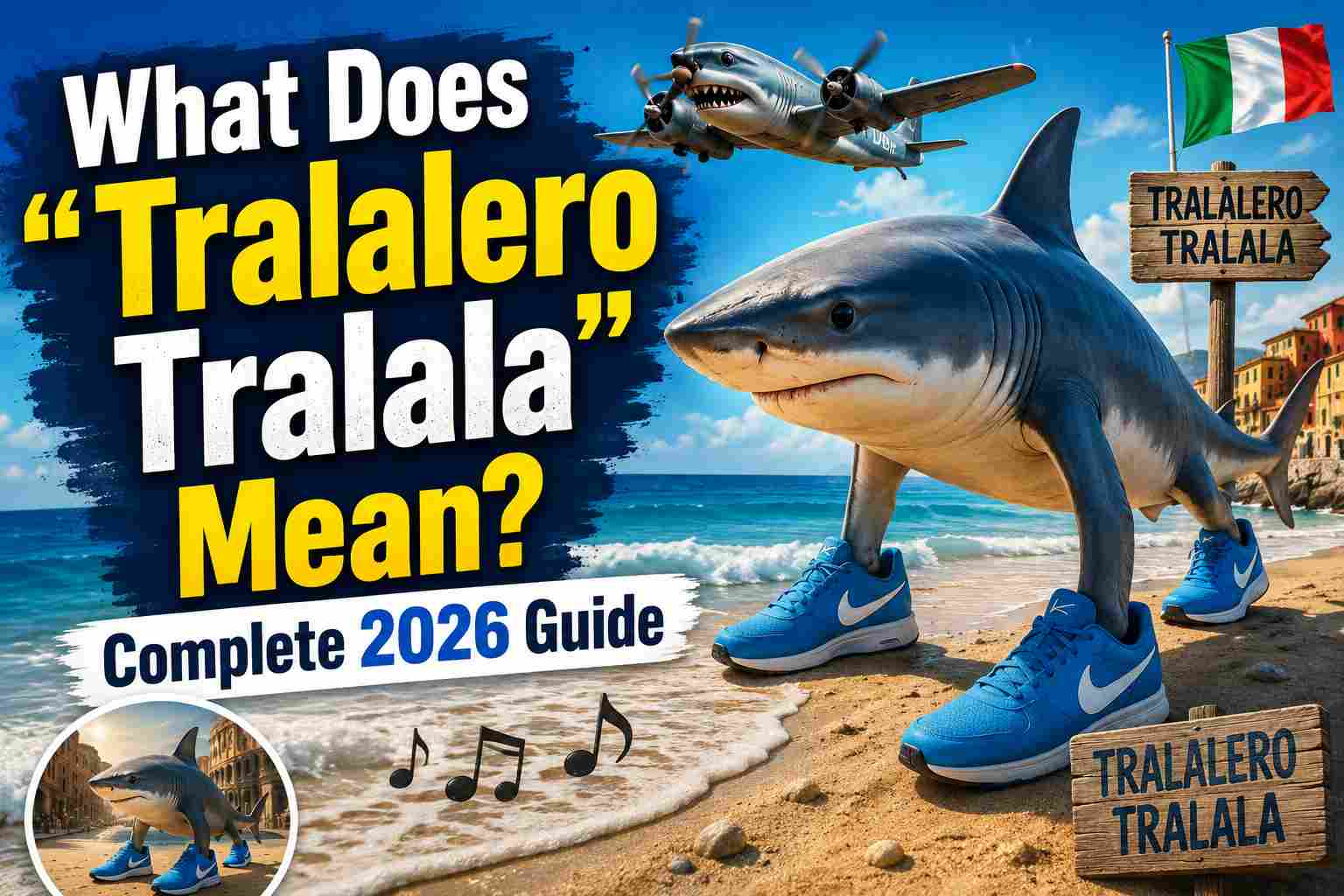
What Does “Tralalero Tralala” Mean? Complete 2026 Guide
If you have been scrolling through TikTok lately, you have probably heard a robotic Italian voice chanting “Tralalero Tralala” over a surreal video of a shark wearing Nike sneakers. The phrase is everywhere, from meme compilations to comment sections, and people are genuinely asking what it actually means. Is it a real Italian phrase? A joke? A song lyric? Or pure digital chaos?
This complete 2026 guide breaks down the full meaning, origin, viral history, and modern usage of “Tralalero Tralala” so you can understand and use it correctly.
Quick Answer: What Does “Tralalero Tralala” Mean?
“Tralalero Tralala” is a cheerful, rhythmic nonsense phrase that carries no fixed dictionary definition. It expresses playful happiness, carefree silliness, or sarcastic humor depending on how it is used. In early 2025, it exploded online as the name of a viral AI-generated meme character and became the unofficial anthem of the “Italian Brainrot” trend.
In simple terms:
It means whatever the moment calls for. It can signal joy, irony, mental checkout, or pure internet chaos. Its power comes not from words but from feeling and rhythm.
What Does “Tralalero Tralala” Actually Mean?
Literal Meaning (Or Lack of One)
“Tralalero Tralala” does not appear in any Italian dictionary. It is not a phrase with a translatable meaning the way “buongiorno” means “good morning.” Instead, it falls into a category linguists call non-lexical vocables, which are sounds or syllables used in singing and speaking to carry rhythm and emotion rather than information.
Think of humming a tune. Think of chanting “la la la” when you have forgotten the words to a song. That is the category “Tralalero Tralala” belongs to. It is musical expression disguised as language.
The “tra” and “la” syllables have roots in centuries-old European singing traditions. The “-lero” suffix gives it an Italian phonetic texture, making it sound dramatic, musical, and exotic to non-Italian ears. But native Italian speakers would equally recognize it as playful sound rather than real vocabulary.
Emotional Meaning Depends on Context
Even though the phrase has no literal meaning, it carries clear emotional signals. How you use it determines what it communicates. When someone types “tralalero tralala” under a stressful post, they are broadcasting detachment. When a creator uses it as a caption over a happy dance video, it signals pure joy.
Meaning by Context (Clear Breakdown)
| Context | What “Tralalero Tralala” Communicates |
| Happy moment or celebration | Carefree joy and playfulness |
| Response to stress or drama | “I am mentally checked out” or ironic dismissal |
| Meme or reaction video | Absurd humor, chaotic energy |
| Content creation caption | Lighthearted, relatable mood-setting |
| Argument or conflict | Sarcastic indifference or walking away emotionally |
Origins of “Tralalero Tralala”
Traditional Roots (Before the Internet)
The phrase is not a product of the internet. Its roots stretch back centuries into European musical tradition. “Tra-la-la” style syllables appeared in Italian opera as early as the 18th century, used by singers as melodic filler in comedic scenes and folk performances. These non-lexical sounds helped performers maintain tempo when no lyric was needed.
European folk music across Italy, France, and Spain frequently used rhythmic chant syllables during dances and communal singing. Shakespeare’s contemporaries even used similar melodic fillers in comedic songs on stage.
The specific “Tralalero” variant also has deep historic weight. Trallalero is a traditional style of polyphonic Genovese folk singing from Genoa, Italy, where male choral groups perform in tight vocal harmonies without instruments. This centuries-old tradition likely shaped the specific sound of the phrase as it travelled through Italian musical culture.
Evolution Into Internet Culture
The phrase existed quietly in traditional music references for years before the internet got hold of it. In late 2024 and early 2025, it became the name of a viral AI-generated character and sound, launching it from obscure folk tradition into mainstream global internet vocabulary almost overnight.
Linguistic Insight (Why Humans Love This)
Linguists who study phonaesthetics, the science of why certain sounds feel pleasurable, point to alternating rhythmic stress as a key driver of memorability. The cadence of “tra-LA-le-RO tra-LA-la” hits a natural beat that the human brain finds satisfying and easy to recall. This is not a coincidence. It is the same principle that makes nursery rhymes stick in children’s heads long after they first hear them.
Why “Tralalero Tralala” Went Viral in 2025 to 2026
TikTok Algorithm Effect
In early January 2025, TikTok user @eZburger401 posted a video featuring an AI-generated three-legged shark wearing Nike sneakers, narrated by a robotic Italian text-to-speech voice chanting the phrase. The account was later banned for content violations, but by then the audio had already been clipped and reposted by dozens of creators. On January 13, 2025, user @amoamimandy.1a paired the original sound with a new AI-generated shark image that accumulated over 7 million views, cementing the trend.
TikTok’s algorithm rewards short, high-energy, rhythmically compelling content. “Tralalero Tralala” checked every box. It was short, audibly distinctive, and paired with visually absurd AI imagery that made viewers stop scrolling.
AI-Generated Meme Explosion
The “Tralalero Tralala” meme was one of the earliest examples of fully AI-generated internet characters going viral. The character himself, a shark with three legs and blue Nike sneakers, was created entirely through AI image generation tools. Paired with AI voiceover, the result was something that felt uncanny, funny, and completely new.
By February 2025, the sound had spread into anime edits, soccer highlight reels, and reaction videos. One Dio Brando meme remix by creator @xsaladagamer pulled over 3 million plays in a single week. A compilation video alone reached 2.3 million views within its first seven days online.
Absurd Humor Trend
Gen Z internet humor in 2024 and 2025 heavily favored post-ironic, overstimulating, and deliberately low-effort content. The more chaotic and inexplicable something was, the more shareable it became. “Tralalero Tralala” fit this perfectly. It asked nothing of its audience except to experience it, laugh, and pass it on.
The “Italian Brainrot” Meme Explained
What Is “Italian Brainrot”?
Italian Brainrot, also called AI Italian Animals, is a genre of meme content that emerged on TikTok in early 2025. It features AI-generated hybrid creatures with pseudo-Italian names, narrated by a robotic Italian text-to-speech voice delivering absurd, rhyming commentary. The characters combine animals with objects, vehicles, or food in surreal ways. A crocodile merged with a bomber plane. A wooden log wielding a bat. A banana fused with a chimpanzee.
The term “brainrot” comes from “brain rot,” which Oxford named its 2024 Word of the Year, defining it as the perceived deterioration of one’s mental state from overconsumption of trivial online content. Fans embraced the label with full self-awareness.
The Role of “Tralalero Tralala”
“Tralalero Tralala” was the first character of the Italian Brainrot universe and the one that started everything. The shark with Nike sneakers became the founding icon of the genre. Other famous characters followed, including Bombardiro Crocodilo, Tung Tung Tung Sahur, Lirilì Larilà, and Chimpanzini Bananini. But it was Tralalero Tralala who opened the door.
Here is a quick reference of the major Italian Brainrot characters:
| Character | Description |
| Tralalero Tralala | Three-legged shark in Nike sneakers, the original character |
| Bombardiro Crocodilo | Crocodile-bomber plane hybrid |
| Tung Tung Tung Sahur | Anthropomorphic wooden log with a bat |
| Lirilì Larilà | Cactus-elephant fusion with flippers |
| Chimpanzini Bananini | Banana-chimpanzee hybrid in a green suit |
| Brr Brr Patapim | Tree-monkey hybrid known for poetic chants |
Why It Feels Addictive
The Italian Brainrot genre works because it is AI-native, remixable, visually overstimulating, and culturally barrier-free. The nonsense audio removes the need for language comprehension. The absurd visuals trigger curiosity. The rhythm makes everything stick. Research from MIT Media Lab indicates that rhythmic, melodic phrases trigger significantly higher recall than standard sentences, which explains why “Tralalero Tralala” lodged itself in so many brains so quickly.
Controversies and Misinterpretations
Does It Have Offensive Meaning?
The original audio posted by @eZburger401 contained explicitly vulgar and religiously offensive content in the narration. The robotic Italian voice chanted phrases that, when translated, included profanity directed at religious figures. This is why the original account was banned from TikTok. The full original voiceover was not simply a cheerful nonsense phrase but a provocative mix of absurdist humor and crude language.
So Why the Confusion?
As the meme spread and remixes multiplied, creators separated the character and the phrase from the original offensive audio. The shark, the name, and the rhythmic chant of “Tralalero Tralala” took on a life independent of the source material. Most viral uses of the phrase in 2025 and 2026 carry none of the original offensive connotations. They simply reference the character or use the phrase for its playful rhythm.
Important Clarification
Using “Tralalero Tralala” as a casual, cheerful expression today is generally harmless. The phrase itself holds no slur, no hate speech, and no inherently offensive content. However, sharing the original unedited audio is a different matter, as it does contain language that many people find deeply offensive. Context and which version you use matters significantly.
How People Use “Tralalero Tralala” Today
On Social Media
On TikTok, Instagram Reels, and YouTube Shorts, the phrase shows up in video captions, comment sections, and as audio overlays. It signals that the creator is embracing chaos, lightness, or absurdist energy. Posts using phrases from the Italian Brainrot universe have consistently shown higher engagement rates than standard captions on short-form video platforms.
In Conversations
In casual chat messages, the phrase functions similarly to “lol” or “whatever,” but with a more playful and culturally specific flavor. Saying “tralalero tralala” in a text conversation after something stressful is a way of communicating “I have mentally moved on from this” without being blunt or dismissive.
In Content Creation
Creators use the phrase to brand themselves as culturally literate with Gen Z internet humor. It functions as an instant in-group signal, telling younger audiences that the creator understands current meme language. It also works as a punchline, a transition sound, or a simple mood-setter in video content.
Real Examples (Relatable and Practical)
Here are everyday scenarios where you will encounter or might naturally use the phrase:
- After a long work meeting: Posting a video captioned “tralalero tralala” communicates joyful freedom without a single explanatory word.
- Reacting to drama online: Commenting the phrase under a chaotic thread signals amused detachment rather than emotional involvement.
- Gaming content: Streamers use it to underscore a player doing something completely unhinged or accidentally brilliant.
- Meme edits: Creators cut the AI chant into sports highlights, anime fight scenes, or cooking videos to create absurd contrast humor.
Similar Phrases Around the World
Nonsense musical phrases like “Tralalero Tralala” are not unique to Italian culture. Human languages across the globe have their own equivalents:
| Phrase | Origin | Meaning or Use |
| La la la | English, widespread | Carefree singing, ignoring something |
| Tra-la-la | English and European | Old-fashioned cheerful filler |
| Ay ay ay | Spanish | Expressive vocal filler for emotion |
| Lalala (ラ・ラ・ラ) | Japanese | Pop song filler, joy and nostalgia |
| Tralala | French | Casual, carefree expression |
| Do re mi | European musical tradition | Scale syllables used in teaching |
What all of these have in common is that they use open vowel sounds in a repeating rhythm, which phonaesthetics research consistently shows humans find universally pleasing.
Why Nonsense Phrases Go Viral (Psychology)
Key Reasons:
The virality of “Tralalero Tralala” is not random. It follows a formula backed by research into how humans process and share information online.
Rhythmic sounds activate the brain’s reward centers in a way that flat prose simply does not. When a phrase has a beat, the brain tags it as memorable. Nonsense removes the cognitive load of meaning-making, which makes sharing feel effortless.
Cultural novelty also plays a role. The Italian phonetic texture felt exotic to English-speaking internet audiences, giving the phrase a personality that made it stand out. Finally, in-group identity drives engagement. Knowing what “Tralalero Tralala” references signals that you are plugged into current internet culture.
Viral Formula
| Element | Why It Works |
| Short and rhythmic | Easy to remember, easy to repeat |
| No fixed meaning | Applies universally to any emotional moment |
| Exotic phonetic texture | Feels fresh and distinctive |
| Meme character attached | Visual anchor makes it recognizable instantly |
| Remixable audio | TikTok creators can reuse and adapt endlessly |
“Tralalero Tralala Meaning in English” Explained
There is no direct English translation because the phrase is not a real word in any language. If you had to capture the English conceptual equivalent, it would be something like “la la la, I am carefree and not taking any of this seriously.” It communicates a mood, not a message.
The closest English expressions would be “whatever, I am vibing” or “I am in my happy place.” The phrase condenses all of that into a sound that is more musical, more fun to say, and far more shareable.
When NOT to Use “Tralalero Tralala”
Understanding when a phrase is inappropriate matters just as much as knowing how to use it. Avoid the phrase in these situations:
- Formal professional settings such as work emails or client communications
- Conversations involving serious grief or emotional distress
- Academic writing of any kind
- Sharing the original unedited audio in mixed audiences, due to its offensive source content
Future of the Trend (2026 and Beyond)
What Is Next?
The Italian Brainrot universe has already expanded well beyond TikTok. In 2025, Italian newsstands began selling official “Skifidol Italian Brainrot Trading Card Games.” Panini released an official sticker album. The Roblox game “Steal a Brainrot” attracted millions of players. These developments signal that the phenomenon has crossed from internet subculture into mainstream commercial entertainment.
“Tralalero Tralala” as a phrase will likely outlive the peak trend period because it achieved something rare: it separated from its original source material and became a freestanding cultural reference with multiple layers of meaning.
Trend Prediction Table
| Time Period | Likely Status of the Trend |
| Mid-2025 | Peak virality, maximum meme production |
| Late 2025 | Plateau, mainstream audiences fully aware |
| 2026 | Settled into casual cultural vocabulary, nostalgic callbacks |
| 2027 and beyond | Niche continued use, “throwback” meme territory |
The phrase is unlikely to disappear entirely. Like “yolo” or “lol,” it will settle into a lower-profile existence as a recognized cultural artifact long after its viral peak has passed.
You can also chckout thi article as well 123+ Best Funny Building Puns [2026 Trending Edition]
Conclusion
“Tralalero Tralala” began as a centuries-old musical tradition and evolved into one of 2025’s most recognized internet phrases. Its meaning is fluid, its energy is contagious, and its power lies in emotion rather than definition.
Whether you encounter it as a meme, a caption, or a sound stuck in your head, you now know exactly what it means and where it came from.

Hi, I’m Thomas Shelby, a passionate writer who loves creating witty, family-friendly puns that make people smile. I share fresh, creative, and original wordplay across every topic, helping readers find the funniest jokes, clever captions, and pun ideas for any occasion.